
Steering vs. Controlling
Why one exhausts you and the other sets you free

A few days ago I applied online to a local place I really want to work.
I got dressed, drove the 20 minutes up the road, and walked in with my resume in hand. I made my interest known by showing up in person. I did what I could to signal to them how interested I was in the opportunity.
And then I chose not to spiral.
That might not sound like such a big deal. But oh it is! For someone who spent decades trying to control outcomes, choosing not to spiral was actually enormous progress. No monitoring, over-explaining, anticipating, or white-knuckling every possible scenario.
I dropped off the resume. I made my interest known. And then I stepped back.
That move in itself is new behavior.
That’s steering.
I’ve been sitting with this distinction lately of steering versus controlling. I’ve been living it in real time. And the difference between the two is something I feel in my body now more than I can explain in my head.
Control was something I learned early. It made sense at the time and it is what I knew. It worked for me. It kept things moving forward on my schedule, it gave me security knowing things were properly taken care of, and it provided me with a boost of confidence that I was the one pulling the strings.
If I could manage enough variables, anticipate enough outcomes, hold enough things together, maybe I could keep the whole thing from falling apart. And most of the time, I could.
But this type of behavior is exhausting emotionally and physically.
When you’re controlling, you’re not just managing your own life. You’re trying to manage reality itself. You are trying to manage the timing of when things happen, other people’s moves, the potential outcomes, and all the to-do’s that come with the territory.
You become personally responsible for holding the universe together. Not only is that an impossible task, it is also a good way to run yourself into the ground.
Recently I’ve been working with someone on a new project that fits me perfectly.
Early in the process I noticed the old pull. The urge to over-function and carry the weight of the whole thing. I had to remind myself that I was hired for specific tasks, not to take over someone’s world. But to me, that level of know-how and quick action was easy to fall into without much thought.
I caught myself. And in my mind I heard a wise voice say:
You are here to help steer this. You are not here to control her whole world.
That was enough to remind me of what I value. How the new me wants to show up now.
I stayed in my lane. I offered perspective when it was useful. I trusted her to carry what was hers to carry. I made suggestions without needing them to land a certain way.
The project moved forward. Better, actually, than it would have if I had tightened my grip.
That’s the thing about steering. Other people can breathe inside it.
Control often doesn’t leave room for that.
Control feels like gripping and forcing. There’s constant monitoring and anticipation. So many expectations are involved and no amount of over-explaining seems to get everyone on the same page.
Steering feels like adjusting, guiding, and responding. It’s trusting that movement is happening even when you can’t see all of it.
It’s easy to confuse control with love, responsibility, emotional intelligence, and safety.
If I’m managing everything, you’ll know how much I care. If I’m anticipating every outcome, I am seen as responsible. If I’m holding it all together, I have purpose.
Steering requires something harder than all of that.
It requires trusting yourself enough to respond in real time instead of trying to eliminate uncertainty altogether.
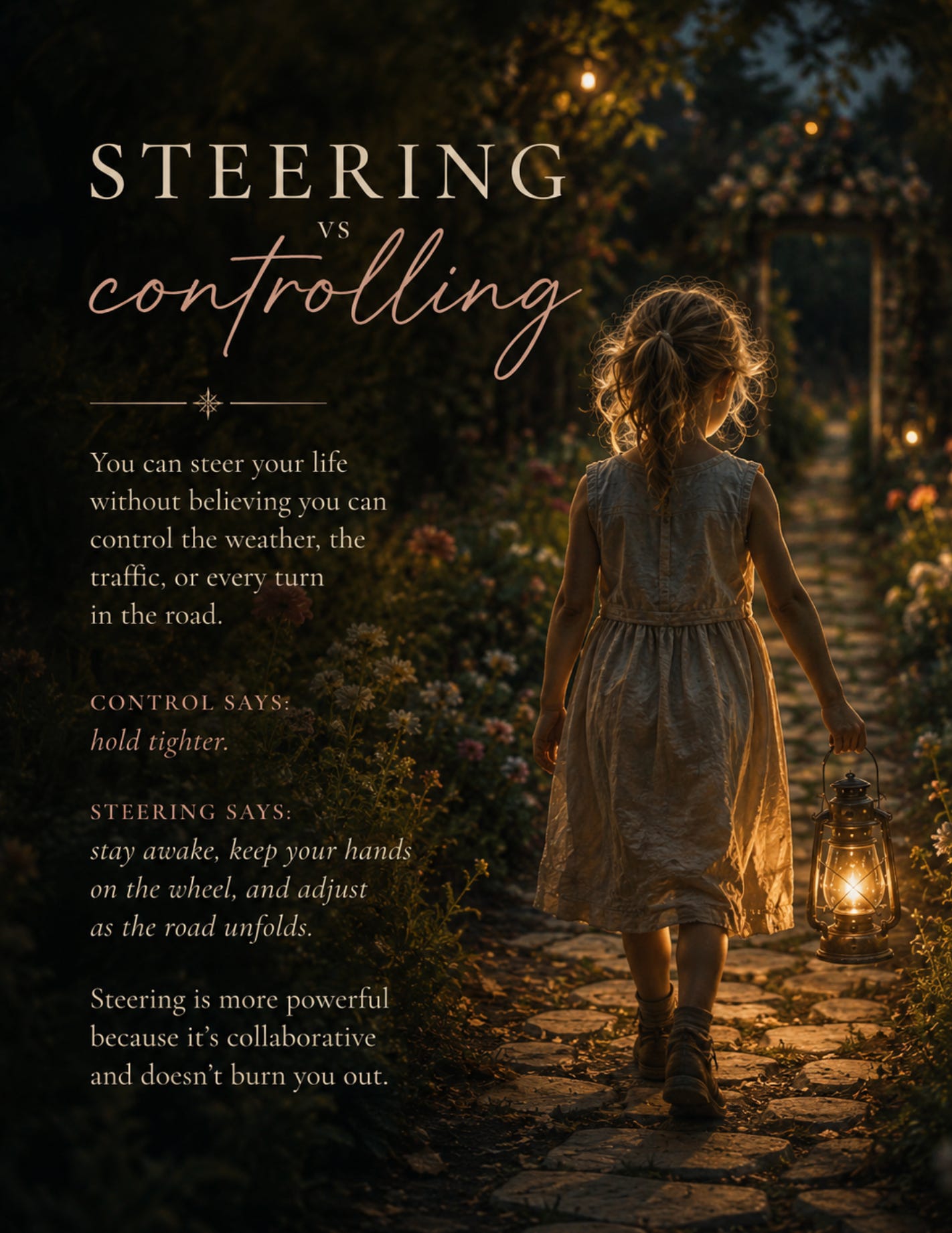
Think about driving a car.
When you steer, you make constant small adjustments. You read the road. You respond to what’s actually in front of you. You don’t grab the wheel in terror every three seconds trying to force the road to obey you.
You participate, influence, and make decisions in the moment.
You accept that the road has its own weather, other drivers, and unexpected hairpin turns.
You stop acting like your grip is the only thing keeping everything from flying apart.
That’s where the peace starts to come from.
Not from having more control. From finally trusting yourself enough to steer.
Control was survival for a long time. I understand why I needed it.
And I’m learning that I don’t need it the same way anymore.
Steering is what comes next.
It’s calmer and quieter. It’s more collaborative. It leaves room for other people to show up.
And it leaves room for me to breathe too.
All love,
Sue
Oh this is so full of lived wisdom! You’re also showing how growth happens, in those choices to try it differently.